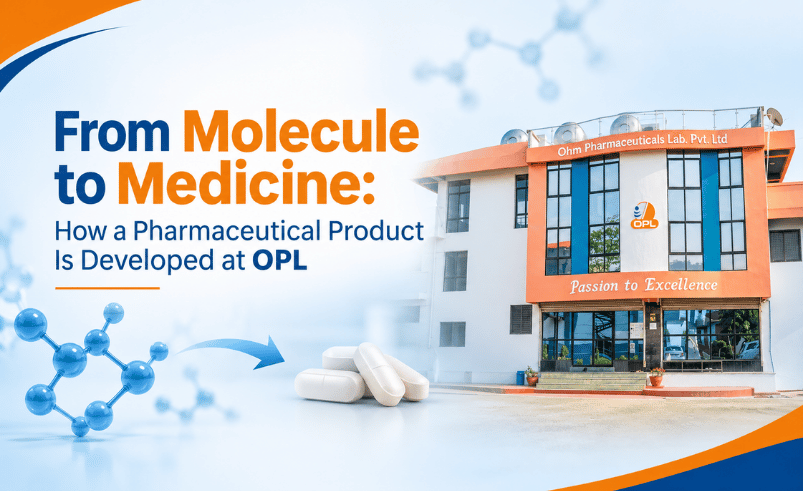
From Molecule to Medicine: How a Pharmaceutical Product Is Developed at OPL

Where science meets quality, patient needs, and trust

Every medicine has a journey.

Long before a tablet reaches a patient’s hands, it begins with a molecule, a healthcare need, and a vision to make treatment better and more accessible.

But how does a molecule become a medicine?

The journey involves much more than manufacturing. It brings together pharmaceutical science, formulation development, quality, stability, regulatory compliance, manufacturing, and—most importantly—the needs of the patient.

At Ohm Pharmaceuticals Laboratories Pvt. Ltd. (OPL), this journey is guided by a commitment to quality, patient acceptability, safety, and affordability.


OPL: From Pharmaceutical Science to Trusted Medicines

At Ohm Pharmaceuticals Laboratories Pvt. Ltd. (OPL), quality is at the centre of the journey from molecule to medicine.

OPL is a WHO-GMP-certified pharmaceutical company committed to producing high-quality, safe, effective, and affordable medicines.

A significant milestone in OPL’s journey is becoming the first pharmaceutical company in Nepal to receive WHO-GMP certification for hormonal drugs. This achievement reflects OPL’s commitment to robust manufacturing systems, quality assurance, regulatory compliance, and internationally recognized manufacturing practices.

With expertise across hormonal, steroid, urology, and general pharmaceutical products, OPL continues to strengthen its manufacturing capabilities while keeping quality and patient needs at the centre of its work.


It Starts With a Molecule

At the heart of every medicine is an Active Pharmaceutical Ingredient (API)—the substance responsible for the intended therapeutic effect.

But an API alone is not a medicine.

Scientists and pharmaceutical professionals must understand its properties, stability, compatibility, and suitability for formulation. This scientific understanding becomes the foundation for developing a product that can deliver consistent quality, performance, and stability.


From Molecule to Formulation

The next step is to transform the active ingredient into a suitable dosage form.

Depending on the medicine, this may involve tablets, capsules, liquids, creams, or other pharmaceutical forms.

Formulation development considers several factors:

Stability • Dosage • Performance • Manufacturing Feasibility • Patient Acceptability

A medicine must not only contain the right active ingredient—it must also be designed in a form that patients can use conveniently, consistently, and comfortably.

Because the final destination of every medicine is the patient.


From Laboratory to Manufacturing

A formulation that works in the laboratory must also be capable of being manufactured consistently at scale.

This means developing and controlling processes for:

Raw Materials → Manufacturing → In-Process Controls → Quality Testing → Packaging → Finished Product

The objective is not simply to make one good batch.

The goal is to make every batch consistently meet the required quality standards.

This is where Good Manufacturing Practices (GMP) become essential—helping ensure that pharmaceutical products are consistently produced and controlled according to appropriate quality standards.


Quality Is Built Into the Medicine

Quality cannot simply be tested into a product at the end.

It has to be built into the entire process—from development and raw materials to manufacturing, testing, packaging, and release.

That means every stage matters:

  • Right Material.
  • Right Process.
  • Right Controls.
  • Right Testing.
  • Right Documentation.

This quality-focused approach helps minimize risks and supports the consistent production of medicines that meet defined quality standards.

At OPL, quality control involves the analysis of raw materials, intermediate products, and finished products using pharmacopoeial standards and validated procedures.


Stability, Safety & Consistency

A medicine must remain within its required quality specifications throughout its intended shelf life.

Therefore, stability studies help determine how a product behaves over time under defined storage conditions.

Packaging, storage conditions, manufacturing processes, and product characteristics all contribute to maintaining the quality of a medicine.

So pharmaceutical development asks not only:

“Is this medicine suitable today?”

but also:

“Will it remain suitable throughout its intended shelf life?”


Quality That Patients Can Accept

A medicine may be scientifically sound, but its success also depends on whether patients can accept and use it comfortably.

Patient acceptability can involve:

  • Appropriate dosage forms
  • Convenient administration
  • Suitable product characteristics
  • Clear information and packaging
  • Consistent quality
  • Affordability

At OPL, patient needs are considered alongside quality and affordability, because the ultimate purpose of pharmaceutical development is to contribute to better healthcare.


Quality With Affordability

Access to quality medicines is an important part of better healthcare.

OPL believes that quality and affordability should go hand in hand.

The aim is to develop and manufacture medicines that meet appropriate quality standards while remaining accessible to the patients and communities who need them.

Because affordable medicine should never mean compromised quality.

This commitment is reflected in OPL’s quality policy, which emphasizes producing safe, stable, and effective medicines at an affordable price.


The Journey at a Glance

Healthcare Need

↓
Molecule / Active Ingredient
↓
Formulation Development
↓
Process Development
↓
Stability & Quality Evaluation
↓
Regulatory Compliance
↓
GMP Manufacturing
↓
Quality Testing & Release
↓

Patient

Every step adds another layer of science, control, quality, and responsibility


From Molecule to Medicine. From Quality to Trust.

A medicine is more than a tablet, capsule, or bottle.

Behind every pharmaceutical product is a journey of research, science, technology, quality systems, skilled people, and continuous improvement.

At OPL, that journey is driven by a simple belief:

Quality for today. Trust for tomorrow. Better healthcare for everyone.

From the first molecule to the finished medicine, OPL remains committed to its philosophy of “Passion to Excellence”—developing and manufacturing medicines with a focus on quality, patient acceptability, safety, and affordability.

From molecule to medicine.

From quality to trust.

From science to better healthcare.

नेपाली औषधि उद्योगले विदेशी उद्योगसँग प्रतिस्पर्धा गर्न सक्छन्

नेपाल औषधि अवस्था अहिलेसम्म राम्रै भन्नुपर्ने अवस्था छैन । आर्थिक मन्दीको अवस्था रहेको नेपाली औषधिको बजार खस्कँदो अवस्थामा रहेको छ । 

नेपालमा ९० अर्ब रुपियाँ बराबरको औषधीको बजार रहेको छ । त्यसमध्ये नेपाली औषधिको ३४ देखि ३५ अर्ब बराबरको बजार रहेको छ । समग्र औषधिको हिसाव गर्ने हो भने ५० प्रतिशत औषधिको हिस्सा नेपालमा नै उत्पादन भएका औषधिहरुको रहेको छ । हामी अहिले सरकारको सहयोग विना नै आफ्नै मिहनेतले नेपाली औषधि उद्योगलाई अगाडि बढाइरहेका छौँ । 

नेपाली औषधि उद्योगको मुलुकका लागि आवश्यक ७० देखि ८० प्रतिशत औषधि उत्पादन गर्ने क्षमता रहेको छ । तर उद्योगहरु पूर्ण क्षमतामा संचालनमा आउन सकेका छैन । अहिले ३० देखि ३५ प्रतिशत क्षमतामा मात्र संचालन रहेका छन् । 

सरकारले नेपाली औषधि उद्योगका लागि के गर्नुपर्यो ? 

नेपाली औषधि उद्योगमैत्री खालका कार्यक्रम सरकारले ल्याउनु पर्दछ । नीजि उद्योगले एक हदसम्म लगानी गरिरहेका छन् । अर्को कुरा बाहिरी मुलुकबाट औषधि नेपाल आइरहेका छन् । त्यसैगरी सरकारले बाहिर मुलुकमा पनि हामीलाई औषधि निर्यात गर्न सक्ने वातावरण बनाइदिनु पर्दछ । 

सरकारले सरकारी तवरबाट खरिद गर्ने औषधि स्वदेश उद्योगले उत्पादन गरेका औषधि खरिद गरिदियो भने हामीलाई उद्योग संचालन गर्न सहज हुने र मुलुकलाई चाहिने औषधि पनि उत्पादन गर्न सक्छौ । 

नेपाल फर्मा एक्स्पो किन आवश्यक पर्यो ? 

एक्स्पोको मुख्य उद्देश्य नेपाली औषधिलाई चिनाउने नै हो । नेपालमा करिव ८४ वटा औषधि उद्योग रहेका छन् । नेपाली उद्योगले गुणस्तर, असरदार र सस्तोमा औषधि उत्पादन गर्दछन भनेर सर्वसाधारणलाई जानकारी दिनका हामीले हरेक दुई–दुई बर्षमा एक्स्पो गर्न थालेका हौ । 

नेपालका औषधि भारत लगायत विदेशी औषधिको तुलनामा कतिको गुणस्तर र सस्तो छन् ? 

कुनै पनि नेपाली उद्योगले उत्पादन गरेको औषधि नराम्रा छैनन् । यहाँका औषधि विश्व स्वास्थ्य संगठनको जिएमपीमा नै रहेको छ । नेपाली उद्योग कुनै पनि विदेश उद्योगसंग प्रतिस्पर्धा गर्न योग्य छन् । 

यस्तै अहिले औषधिको बजारभाउ धेरै नै माथि पुगि सकेको छ । तर हामीले अझै पनि पुरानै मूल्यमा सस्तो दरमा औषधि उपलब्ध गराएका छौ २०६४ सालदेखि हामीले औषधिको मूल्य समायोजन गर्न पाएका छैनौ । हामीले मुलुकको अवस्था हेरेर अहिले सस्तो दरमा औषधि उपलब्ध गराएका छौ । यहाँका सर्वसाधारणको पर क्यापिटा इनकम हेरेर र भारतसाग दाँजेर नै हामीले सस्तोमा औषधि उपलब्ध गराएका हौ । 

भारतमा एक अर्ब ३० करोड मानिस रहेका छन् । भारतले त्यही अनुपातमा औषधि उत्पादन गर्दछ । तर पनि महंगोमा नै वेच्ने गर्दछ । हामी तीन करोड जनसंख्यालाई लक्षित गरेर औषधि उत्पादन गर्दछौ तर पनि हामी सस्तो र गुणस्तरिय औषधि उत्पादन गरिरहेका छौ । औषधि व्यवस्था विभागबाट हाम्रो बारम्बार अनुगमन हुन्छ । विभागको मापदण्ड विश्वस्तरिय रहेको छ । त्यसैले हामी गुणस्तरमा ध्यान दिन्छौ । हाम्रो औषधिका क्यालिटी विश्वका अन्य औषधिको तुलनामा नै रहेको छ । 

औषधि खाएपछि त्यो औषधिले काम गनुपर्दछ । त्यसैले हामीले गुणस्तरसंगै असरदार औषधि बनाएका छौ । नेपालका औषधि गुणस्तरिय, किन्ने सक्ने र अवसदार छन् । यी तिनैवटामा हामी रहेका छौ । 

उद्योगहरु किन बन्द भएका होलान ? 

हाम्रा आफ्नै पनि केही कमजोरी रहेका छन् । उद्योग बन्द हुनुमा विभिन्न अरु पनि आफ्नै कारण होलान् । तर मार्केट अहिले आर्थिक मन्दी रहेको छ । त्यसले गर्दा हामी प्रतिस्पर्धा गर्न सकेका छैनौ । कतिपय साथीहरु एकै किसिमका प्रडक्ट र नयाँ–नयाँ प्रविधि ल्याउन सकेका छैनौ । हामीले अरुले जे गर्यो त्यही गर्ने बानी रहेको छ । औषधि उद्योगमा पनि एकै खालका औषधि उत्पादनले पनि समस्या परेको छ । हामी अलि फरक ढंंगले उद्योगलाई लैजाने कोसिस गरिरहेका हुन्छौ तर केही कारण हुन सक्दैनौ । दोष हामी आफैमा छ अरुलाई दिनुहुँदैन । 

अनि अर्को कुरा सरकारले पनि हामी उद्योगीलाई संरक्षण गर्ने खालका नीति ल्याउनु पर्दछ । सरकारले खरिद गर्ने औषधि स्वदेशी उत्पादनका औषधि खरिद गरिदिने हो भने हामीलाई उद्योग बचाउन सजिलो हुन्छ । 

सरकारको सहयोग किन भइरहेको छैन ? 

सरकारले हामीलाई हेर्ने नजरमा परिवर्तन गरोस भनेर नै फर्मा एक्स्पो गर्न थालेका हौ । सरकारलाई हाम्रा कुरा सवै थाहा छैन । हामी आफैलाई पनि सवै थाहा छैन । विस्तारै बुझ्दै छौ । सरकार समक्ष हामीले हाम्रा कुरा पुर्याउन सकेनौ जस्तो लाग्छ । हामीले आफ्ना कुरा आफैले सरकार समक्ष राख्नुपर्यो । हो त्यही कुरा सरकारलाई पुर्याउनका लागि एक्स्पो गर्न थालेका हौ । 

नयाँ औषधि ऐन आइरहेको छ । नेपाली औषधि उद्योगका लागि के कुरा नयाँ ऐनमा राख्नुपर्दछ ? 

नयाँ बन्न थालेको औषधि ऐनमा धेरै राम्रा कुरा रहेका छन् । मूल्य समिति गठन गरेर औषधिको मूल्य समायोजन गरिने कुरा राखेको सुनेको छु । त्यो एकदम राम्रो हो । विगत १६ बर्षदेखि औषधिको मूल्य समायोजन हुन सकेको थिएन । पुरानो औषधि ऐनमा कुनै वाधा अडचन छ भनेर नयाँ बन्न थालेको औषधि ऐनमा फुकाउनुपर्दछ ।

नेपाली औषधि उद्योगले विदेशी उद्योगसँग प्रतिस्पर्धा गर्न सक्छन् : सुर्दशन खेगुली, एपोन महासचिव::Online News Portal from Nepal (farakpatra.com)

Obesity

Key facts

Worldwide obesity has nearly tripled since 1975.

In 2016, more than 1.9 billion adults, 18 years and older, were overweight. Of these over 650 million were obese.

39% of adults aged 18 years and over were overweight in 2016, and 13% were obese.

Most of the world’s population live in countries where overweight and obesity kills more people than under-weight.

39 million children under the age of 5 were overweight or obese in 2020.

Over 340 million children and adolescents aged 5-19 were overweight or obese in 2016.

Obesity is preventable.

What are obesity and overweight

Overweight and obesity are defined as abnormal or excessive fat accumulation that may impair health.

Body mass index (BMI) is a simple index of weight-for-height that is commonly used to classify overweight and obesity in adults. It is defined as a person’s weight in kilograms divided by the square of his height in meters (kg/m2).

Adults

For adults, WHO defines overweight and obesity as follows:

overweight is a BMI greater than or equal to 25; and

obesity is a BMI greater than or equal to 30.

BMI provides the most useful population-level measure of overweight and obesity as it is the same for both sexes and for all ages of adults. However, it should be considered a rough guide because it may not correspond to the same degree of fatness in different individuals.

For children, age needs to be considered when defining overweight and obesity.

Children under 5 years of age

For children under 5 years of age:

overweight is weight-for-height greater than 2 standard deviations above WHO Child Growth Standards median; and

obesity is weight-for-height greater than 3 standard deviations above the WHO Child Growth Standards median.

Charts and tables: WHO child growth standards for children aged under 5 years

Children aged between 5–19 years

Overweight and obesity are defined as follows for children aged between 5–19 years:

overweight is BMI-for-age greater than 1 standard deviation above the WHO Growth Reference median; and

obesity is greater than 2 standard deviations above the WHO Growth Reference median.

Charts and tables: WHO growth reference for children aged between 5–19 years

Facts about overweight and obesity

Some recent WHO global estimates follow.

In 2016, more than 1.9 billion adults aged 18 years and older were overweight. Of these over 650 million adults were obese.

In 2016, 39% of adults aged 18 years and over (39% of men and 40% of women) were overweight.

Overall, about 13% of the world’s adult population (11% of men and 15% of women) were obese in 2016.

The worldwide prevalence of obesity nearly tripled between 1975 and 2016.

In 2019, an estimated 38.2 million children under the age of 5 years were overweight or obese. Once considered a high-income country problem, overweight and obesity are now on the rise in low- and middle-income countries, particularly in urban settings. In Africa, the number of overweight children under 5 has increased by nearly 24% percent since 2000. Almost half of the children under 5 who were overweight or obese in 2019 lived in Asia.

Over 340 million children and adolescents aged 5-19 were overweight or obese in 2016.

The prevalence of overweight and obesity among children and adolescents aged 5-19 has risen dramatically from just 4% in 1975 to just over 18% in 2016. The rise has occurred similarly among both boys and girls: in 2016 18% of girls and 19% of boys were overweight.

While just under 1% of children and adolescents aged 5-19 were obese in 1975, more 124 million children and adolescents (6% of girls and 8% of boys) were obese in 2016.

Overweight and obesity are linked to more deaths worldwide than underweight. Globally there are more people who are obese than underweight – this occurs in every region except parts of sub-Saharan Africa and Asia.

What causes obesity and overweight?

The fundamental cause of obesity and overweight is an energy imbalance between calories consumed and calories expended. Globally, there has been:

an increased intake of energy-dense foods that are high in fat and sugars; and

an increase in physical inactivity due to the increasingly sedentary nature of many forms of work, changing modes of transportation, and increasing urbanization.

Changes in dietary and physical activity patterns are often the result of environmental and societal changes associated with development and lack of supportive policies in sectors such as health, agriculture, transport, urban planning, environment, food processing, distribution, marketing, and education.

What are common health consequences of overweight and obesity?

Raised BMI is a major risk factor for noncommunicable diseases such as:

cardiovascular diseases (mainly heart disease and stroke), which were the leading cause of death in 2012;

diabetes;

musculoskeletal disorders (especially osteoarthritis – a highly disabling degenerative disease of the joints);

some cancers (including endometrial, breast, ovarian, prostate, liver, gallbladder, kidney, and colon).

The risk for these noncommunicable diseases increases, with increases in BMI.

Childhood obesity is associated with a higher chance of obesity, premature death and disability in adulthood. But in addition to increased future risks, obese children experience breathing difficulties, increased risk of fractures, hypertension, early markers of cardiovascular disease, insulin resistance and psychological effects.

Facing a double burden of malnutrition

Many low- and middle-income countries are now facing a “double burden” of malnutrition.

While these countries continue to deal with the problems of infectious diseases and undernutrition, they are also experiencing a rapid upsurge in noncommunicable disease risk factors such as obesity and overweight, particularly in urban settings.

It is not uncommon to find undernutrition and obesity co-existing within the same country, the same community and the same household.

Children in low- and middle-income countries are more vulnerable to inadequate pre-natal, infant, and young child nutrition. At the same time, these children are exposed to high-fat, high-sugar, high-salt, energy-dense, and micronutrient-poor foods, which tend to be lower in cost but also lower in nutrient quality. These dietary patterns, in conjunction with lower levels of physical activity, result in sharp increases in childhood obesity while undernutrition issues remain unsolved.

How can overweight and obesity be reduced?

Overweight and obesity, as well as their related noncommunicable diseases, are largely preventable. Supportive environments and communities are fundamental in shaping people’s choices, by making the choice of healthier foods and regular physical activity the easiest choice (the choice that is the most accessible, available and affordable), and therefore preventing overweight and obesity.

At the individual level, people can:

limit energy intake from total fats and sugars;

increase consumption of fruit and vegetables, as well as legumes, whole grains and nuts; and

engage in regular physical activity (60 minutes a day for children and 150 minutes spread through the week for adults).

taking medications like orlistat. (OBESLIM 120 mg capsules)

Individual responsibility can only have its full effect where people have access to a healthy lifestyle. Therefore, at the societal level it is important to support individuals in following the recommendations above, through sustained implementation of evidence based and population based policies that make regular physical activity and healthier dietary choices available, affordable and easily accessible to everyone, particularly to the poorest individuals. An example of such a policy is a tax on sugar sweetened beverages.

Nurture your life with nature’s perfect sleep…

What is melatonin?

Melatonin is a natural hormone that’s mainly produced by your pineal gland, which is a tiny gland in your brain. Your pineal gland is part of your endocrine system. The full impact of melatonin in humans isn’t totally clear, but most research shows it helps to synchronize circadian rhythms in different parts of your body. Circadian rhythms are physical, mental and behavioral changes that follow a 24-hour cycle. The most important and well-known of these circadian rhythms is your sleep-wake cycle. These natural processes respond primarily to light and dark. Your pineal gland secretes the highest levels of melatonin during the night and minimal amounts during the day. 

Melatonin’s effect on sleep

Your pineal gland releases the highest levels of melatonin when there’s darkness and decreases melatonin production when you’re exposed to light. In other words, you have low levels of melatonin in your blood during the daylight hours and peak levels of melatonin during the nighttime. The longer the night, the longer your pineal gland secretes melatonin. Because of this, melatonin has often been referred to as a “sleep hormone.” While melatonin isn’t essential for sleeping, you sleep better when you have the highest levels of melatonin in your body. However, several other factors contribute to your body’s ability to sleep and the quality of the sleep you get. As your pineal gland receives information about the daily light-dark (day-night) cycle from the retinas in your eyes and then releases melatonin accordingly, people with blindness who can’t detect light usually have irregularly synchronized melatonin cycles leading to circadian rhythm disorders.

Other effects of melatonin

Melatonin also interacts with biologically female hormones. Research has shown that it helps in regulating menstrual cycles. Pineal melatonin can also protect against neurodegeneration, which is the progressive loss of function of neurons. Neurodegeneration is present in conditions such as Alzheimer’s disease and Parkinson’s disease. Researchers have found that people who’ve had their pineal gland surgically removed (pinealectomy) experienced an accelerated aging process. Because of this, some scientists think natural melatonin may have anti-aging properties.

What is ovulation induction?

Ovulation induction is the process of using medications to stimulate ovulation in women who have irregular or absent ovulation. According to the National Institutes of Health, 25 to 30 percent of women with infertility have problems with ovulation.

Normal ovulation occurs when the ovary releases a mature egg in preparation for that egg to be fertilized. Normal ovulation occurs roughly once every 28 days during a woman’s menstrual cycle. Intervals of 21 to 35 days are considered acceptable and reflective of normal ovulation. If fertilization does not occur, the mature egg and any supplementary tissues are broken down and cleared from the uterus naturally.

When ovulation happens less than once every 35 days or is unpredictable, it is considered to be irregular. When ovulation is completely unpredictable – in interval or duration – it is considered oligoovulation. If it doesn’t occur at all, it is called anovulation. Ovulatory problems impact fertility by taking away the predictability of ovulation and potentially the availability of an egg to be fertilized.

The goal of ovulation induction is to increase a woman’s chances of conceiving a child, either through sexual intercourse or by using intrauterine insemination (IUI) or another fertility treatment. However, when the absence of ovulation is a symptom of another fertility issue, treating the underlying problem can also restore normal ovulation and fertility.