| Generic Name: |
Prednisolone
|
| Therapeutic Category: |
Glucocorticoids
|
| Pharmacological Class: |
Corticosteroids
|
| Composition: |
Each uncoated tablet contains:
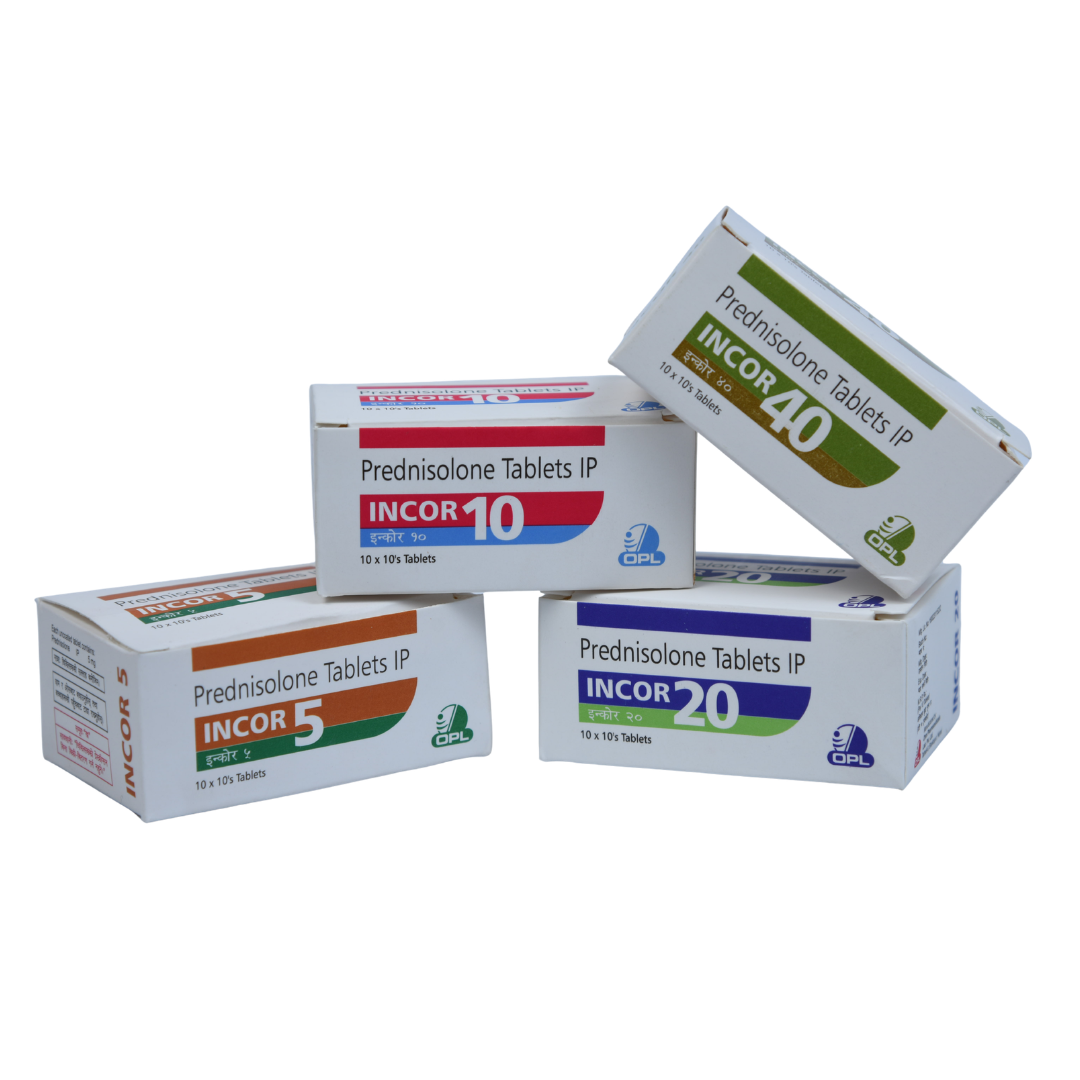
Prednisolone IP 5mg
Prednisolone IP 10mg
Prednisolone IP 20mg
Prednisolone IP 40mg
|
| Pregnancy Category: |
C
This drug should only be used during pregnancy if the benefit outweighs the potential risk to the fetus.
|
| LACTATION: |
Benefit should outweigh risk
Excreted into human milk: Yes
Maternal oral doses up to 40 mg/day are not likely to cause systemic effects in infants, however, doses higher than that may cause a degree of adrenal suppression.
|
| Presentation: |
INCOR 5 – 10 X 10’s
INCOR 10 – 10 X 10’s
INCOR 20 – 10 X 10’s
INCOR 40 – 10 X 10’s
|
| INDICATIONS: |
- Allergic and inflammatory conditions
- Rheumatoid arthritis and autoimmune disorders
- Respiratory disorders
- Skin and ocular disorders
- Endocrine disorders
|
| MECHANISM OF ACTION: |
Naturally occurring glucocorticoids (hydrocortisone and cortisone), which also have salt-retaining properties, are used as replacement therapy in adrenocortical deficiency states. Their synthetic analogs are primarily used for their potent anti-inflammatory effects in disorders of many organ systems.
Glucocorticoids cause profound and varied metabolic effects. In addition, they modify the body’s immune responses to diverse stimuli.
|
| DOSAGE: |
- Systemic Lupus Erythematosus (SLE)
20–60 mg/day depending on disease severity.
- Dermatological Conditions
20–40 mg/day until symptoms subside, followed by gradual tapering.
- Oncology (Palliative Management of Inflammatory Symptoms or as Part of Chemotherapy)
Oral: 10–40 mg/day for symptomatic control.
Administration:
- Preferably administer after food or milk to reduce gastric irritation.
- Long-term therapy should not be stopped abruptly.
- Use the lowest effective dose for the shortest possible duration.
|
| PHARMACOKINETICS: |
Absorption: Well absorbed orally with a good bioavailability.
Distribution: Widely distributed across tissues; crosses the placenta.
Metabolism: Metabolized primarily in the liver.
System Excretion: Excreted in the urine; half-life ranges from 18-36 hours.
|
| ADVERSE EFFECTS: |
The adverse effects are infection (including increased susceptibility and severity of infections with suppression of clinical symptoms and signs), Cushingoid features, sodium retention, fluid retention, affective disorders (including depressed mood and euphoric mood), hypertension, peptic ulcer (with possible perforation and haemorrhage), skin atrophy, acne, and decreased blood potassium levels.
|
| CONTRAINDICATIONS: |
- In patients who have systemic fungal infections.
- In patients who have hypersensitivity to the active substance.
- In patients who have systemic infections unless specific anti-infective therapy is employed.
|
| PRECAUTIONS: |
-
Tuberculosis:
Those with a previous history of, or X-ray changes characteristic of, tuberculosis. The emergence of active tuberculosis can however be prevented by the prophylactic use of anti-tuberculosis therapy.
-
Hepatic disease:
In patients with acute and active hepatitis, protein binding of glucocorticoids may be reduced and peak concentrations increased. Elimination of prednisolone may also be impaired. There is an enhanced effect of corticosteroids in patients with cirrhosis.
-
Corticosteroid requirements may be reduced in menopausal and post-menopausal women.
-
Patients with a history of severe affective disorders and particularly those with a previous history of steroid-induced psychoses.
-
Long-term therapy:
Prolonged use may cause adrenal suppression; gradual withdrawal is recommended to avoid adrenal insufficiency.
|
| DRUG INTERACTIONS: |
- Antacids
The absorption of prednisolone may be reduced by large doses of some antacids such as magnesium trisilicate or aluminium hydroxide.
- Anticoagulants
Response to anticoagulants may be reduced or, less often, enhanced by corticosteroids. Close monitoring of the INR or prothrombin time is required to avoid spontaneous bleeding.
- Antidiabetic agents
Glucocorticoids may increase blood glucose levels. Patients with diabetes mellitus receiving concurrent insulin and/or oral hypoglycemic agents may require dosage adjustments.
- Antibacterials
Rifamycins accelerate metabolism of corticosteroids and thus may reduce their effect. Erythromycin inhibits metabolism of prednisolone and possibly other corticosteroids.
|