| Generic Name: |
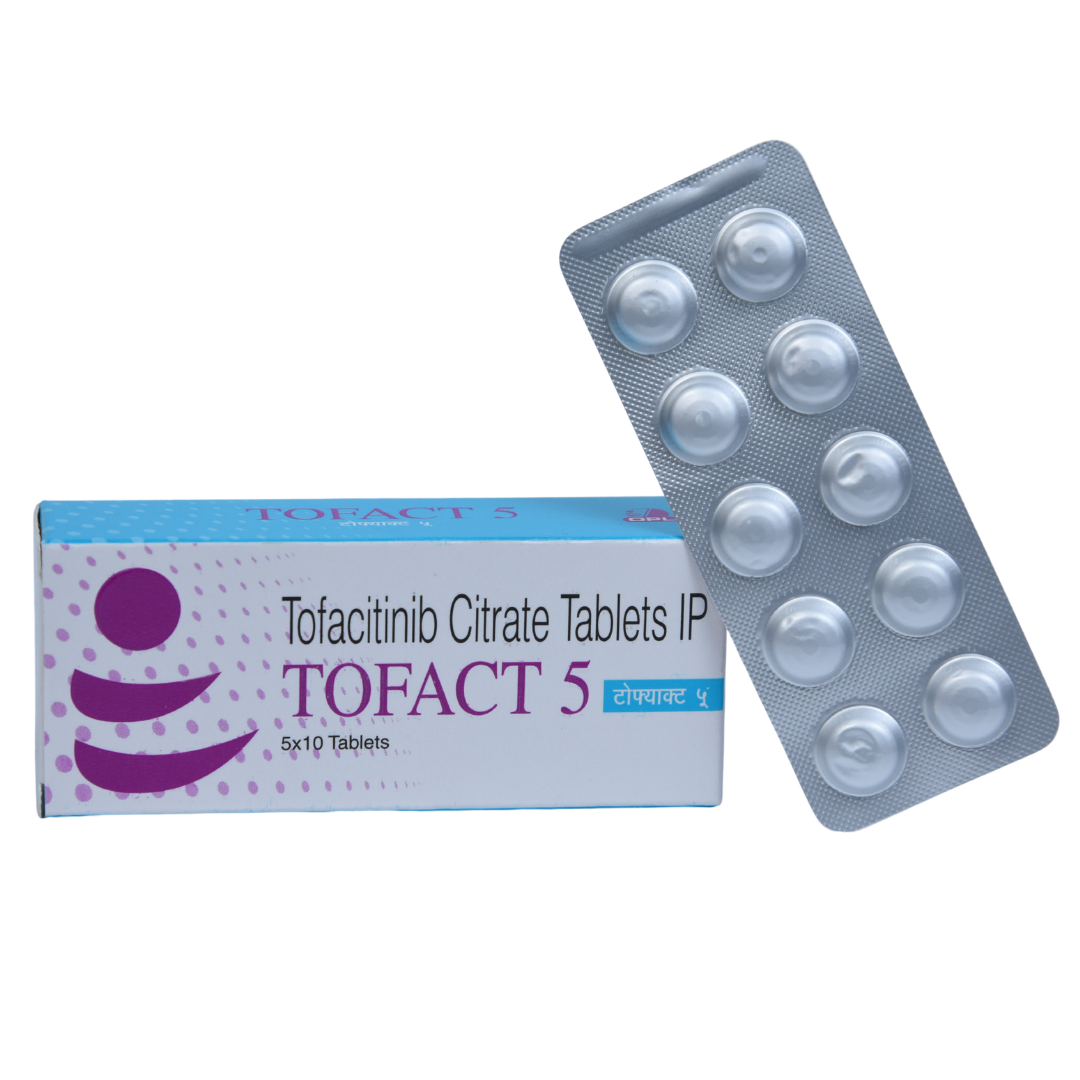
Tofacitinib
|
| Therapeutic Category: |
Immunosuppressants
|
| Pharmacological Class: |
Janus Kinase Inhibitor
|
| Composition: |
Each film coated tablet contains
Tofacitinib citrate equivalent to Tofacitinib 5 mg
|
| Pregnancy Category: |
C
|
| Lactation: |
Contraindicated
|
| Presentation: |
5 X 10’s
|
| INDICATIONS: |
- Rheumatoid arthritis.
- Psoriatic arthritis.
- Ankylosing spondylitis.
- Ulcerative colitis.
- Juvenile idiopathic arthritis.
|
| MECHANISM OF ACTION: |
Tofacitinib is a potent, selective inhibitor of the JAK family. In enzymatic assays, tofacitinib inhibits JAK1, JAK2, JAK3, and to a lesser extent TyK2. In contrast, tofacitinib has a high degree of selectivity against other kinases in the human genome. In human cells, tofacitinib preferentially inhibits signalling by heterodimeric cytokine receptors that associate with JAK3 and/or JAK1 with functional selectivity over cytokine receptors that signal via pairs of JAK2. Inhibition of JAK1 and JAK3 by tofacitinib attenuates signalling of interleukins (IL-2, -4, -6, -7, -9, -15, -21) and type I and type II interferons, which will result in modulation of the immune and inflammatory response.
|
| DOSAGE: |
- Rheumatoid arthritis: 5mg administered twice daily
- Ankylosing spondylitis: 5mg administered twice daily.
- Ulcerative colitis: 10mg given orally twice daily for induction for 8 weeks. For patients who do not achieve adequate therapeutic benefit by week 8, the induction dose of 10 mg twice daily can be extended for an additional 8 weeks (16 weeks total), followed by 5 mg twice daily for maintenance. Tofacitinib induction therapy should be discontinued in any patient who shows no evidence of therapeutic benefit by week 16.
- Juvenile idiopathic arthritis: For 10 – <20 kg: 3.2 mg (3.2 ml of oral solution) twice daily, 20-<40 kg: 4mg (4ml of oral solution) twice daily, >=40 kg: 5mg twice daily.
|
| PHARMACOKINETICS: |
Absorption: Tofacitinib is well-absorbed, with an oral bioavailability of 74%.Coadministration of tofacitinib with a high-fat meal resulted in no changes in AUC while Cmax was reduced by 32%.
Distribution: After intravenous administration, the volume of distribution is 87 L.
Protein Binding: Approximately 40% of circulating tofacitinib is bound to plasma proteins.
Metabolism: The metabolism of tofacitinib is primarily mediated by CYP3A4 with minor contribution from CYP2C19.
Excretion: Clearance mechanisms for tofacitinib are approximately 70% hepatic metabolism and 30% renal excretion of the parent drug.
Half-life: ~3 hours
|
| ADVERSE EFFECTS: |
The adverse effects are Headache, cough, vomiting, diarrhea, nausea, insomnia, pneumonia, tuberculosis, UTI, rash, acne, tendonitis, joint swelling, hypertension, blood creatine and cholesterol increased.
|
| CONTRAINDICATIONS: |
- Hypersensitivity to the active substance or to any of the excipients.
- Active tuberculosis (TB), serious infections such as sepsis, or opportunistic infections.
- Severe hepatic impairment.
- Pregnancy and lactation.
|
| PRECAUTIONS: |
65 years of age and older:
- Patients with history of atherosclerotic cardiovascular disease or other cardiovascular risk factors (such as current or past long-time smokers).
- Patients with malignancy risk factors (e.g. current malignancy or history of malignancy).
- Tofacitinib has not been studied and its use should be avoided in combination with biologics such as TNF antagonists, interleukin (IL)-1R antagonists, IL-6R antagonists, anti-CD20 monoclonal antibodies, IL-17 antagonists, IL-12/IL-23 antagonists, anti-integrins, selective co-stimulation modulators and potent immunosuppressants such as azathioprine, 6-mercaptopurine, ciclosporin and tacrolimus because of the possibility of increased immunosuppression and increased risk of infection.
- In patients with cardiovascular or malignancy risk factors tofacitinib should only be used if no suitable
treatment alternatives are available.
- Tofacitinib should not be initiated in patients with active infections, including localised infections.
|
| DRUG INTERACTIONS: |
- Tofacitinib exposure is increased when coadministered with potent inhibitors of CYP3A4 (e.g., ketoconazole) or when administration of one or more concomitant medicinal products results in both moderate inhibition of CYP3A4 and potent inhibition of CYP2C19 (e.g., fluconazole).
- Tofacitinib exposure is decreased when coadministered with potent CYP inducers (e.g., rifampicin).
|